


Time of synchronization of pendulums of different lengths
- kimayadeshpande18
- Jul 31, 2024
- 1 min read

In this mini-project, I attempted to find the time at which the bobs of pendulums of different lengths align in a straight line, after being released at the same time from the same place.
For this, I graphed SHM equations of a pendulum, namely Y = Acos(ωt)
where ω is the angular acceleration, A is the amplitude, and t is the time elapsed since release.
Here, ω can be written as (2π)/T, where T is the time period of the pendulum.
T = 2π√(l/g). Where l is the sum of the length of the string and the distance between the end of the string and the center of mass of the rod. g is the acceleration due to gravity = 9.81 m/s²
Therefore, the initial equation can be written as:
Y = Acos(t√(g/l))
In the graphs, the y axis is the displacement, and x axis is the time elapsed.
An example: Pendulums of lengths 1 m, 1.2 m, 1.5 m, and 2 m. Amplitude = 2 m, angular velocity = 1 rad/s
What's changing here: The frequency of the cosine wave.

All pendulums start from the same place at the same time.
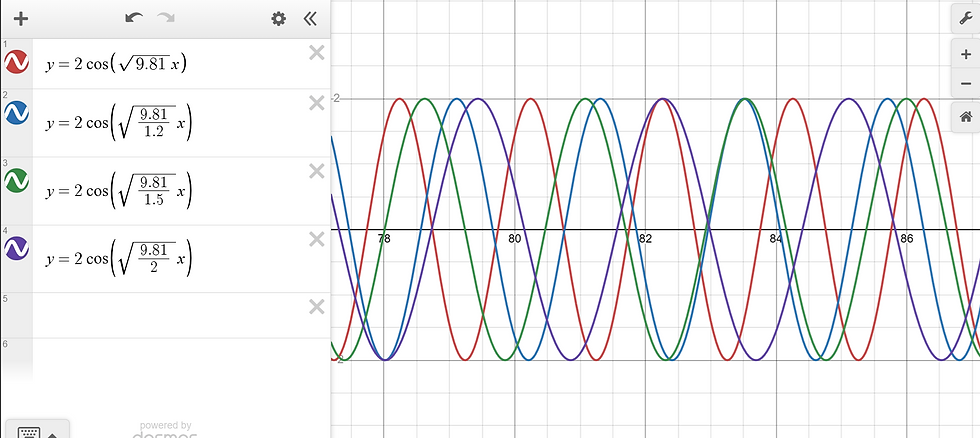
"coupling" of 2 pendulums at approximately 81.5 seconds
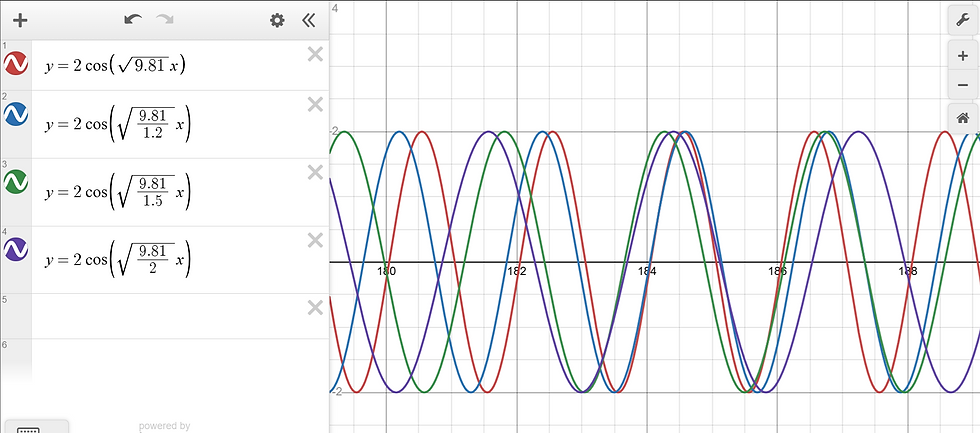
Fastest synchronization at approximately 184.5 seconds
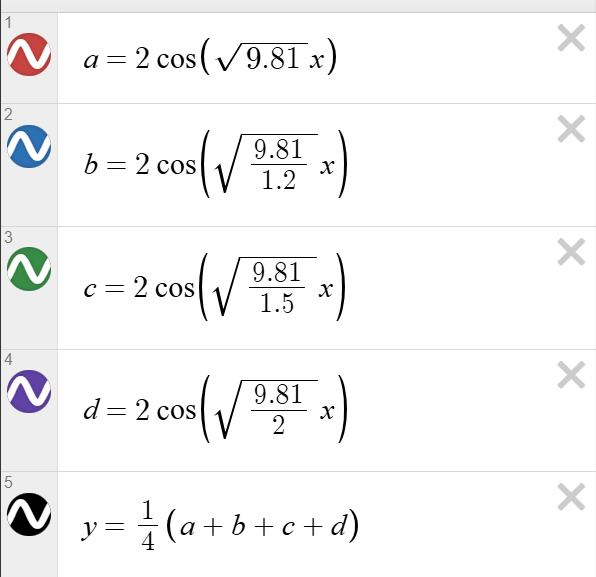
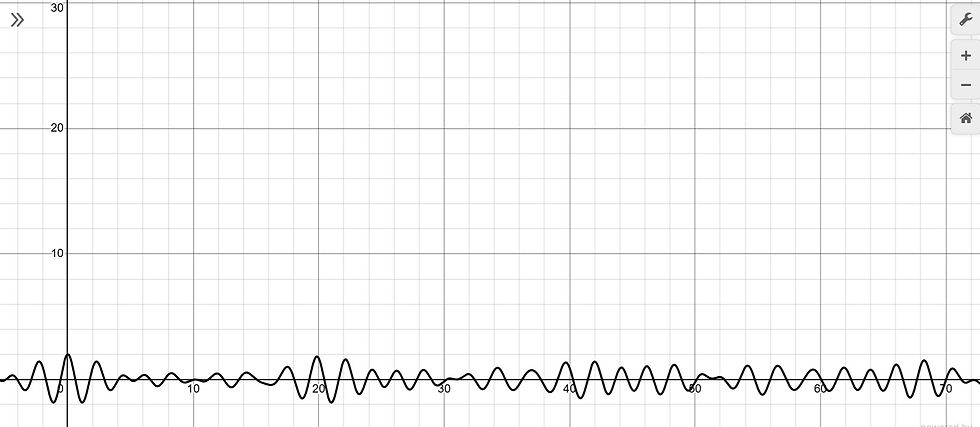
Average angular displacement with respect to time (reminds me of Fourier transform)
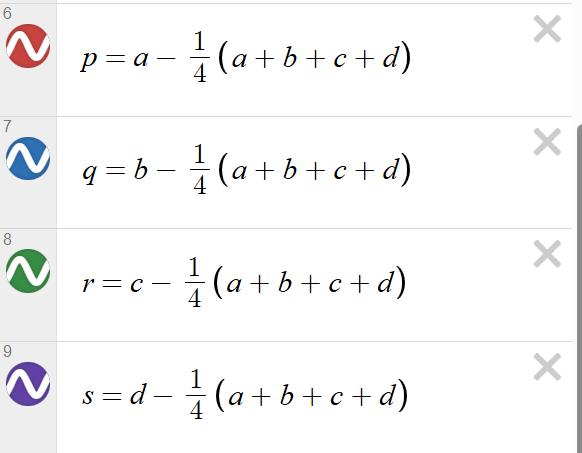
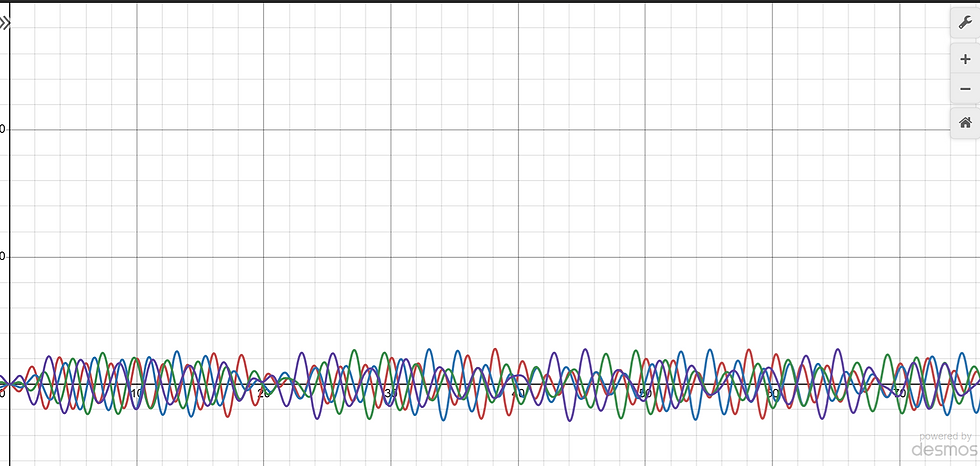
Difference between angular displacement of individual pendulum and the average of angular displacements of all pendulums
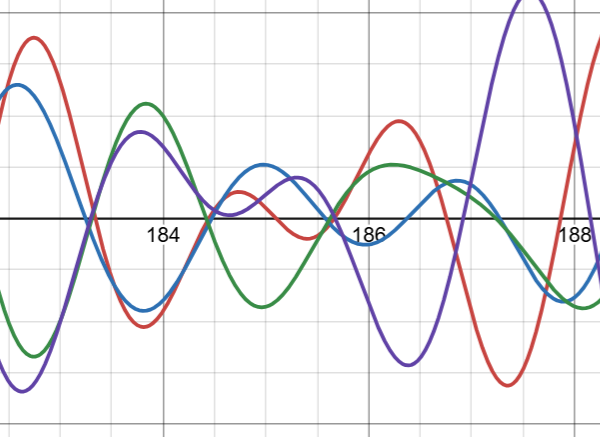
At synchronization


Comments